Yes, I've been invited back to BBC Radio Coventry & Warwickshire tonight for another chat and to read some of my poems - a live programme again, something which always gets the adrenalin flowing! I was only up there a few weeks ago, so they must have liked me, I guess, or at least nobody complained! I'll be talking to Jane Vickers on the evening show, who's standing in for Anita Miah over the Christmas break.
The earlier weather forecasts were for snow tonight in the Midlands but they seemed to be sheepishly changing their tune on the six o'clock news, claiming that there 'might' be some snow in this area, but nothing like the bad drifts they'll be getting to the east and north of us.
But just in case the car gets stranded, I'm taking my husband with me and we should be back home for about 9.30-10pm, which will hopefully mean we'll miss the worst of the cold -- due to hit from about midnight onwards. Anyone in the Warwickshire area who feels like tuning in tonight, I should be on air from about 8-8.30pmish, maybe a little later. Let me know if you do manage to catch it!
Thursday, December 29, 2005


Wednesday, December 28, 2005
a cold shopping we had of it
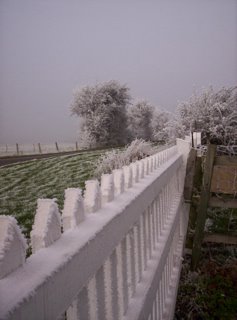
Cold again this morning and more snow forecast. I had to drive into Rugby to buy copier paper - what we used to call 'typing paper'! - and sink into a latte whilst reading more Modern Women Poets; the journey was difficult but not impossible, the parking a nightmare as always at this time of year. Snow is beautiful, of course, but only for short periods. Here comes my anxiety attack again, continuing pollution of the atmosphere, land of the eternal snowscape, Mini Ice Age on the way ...
Tuesday, December 27, 2005
Deryn Rees-Jones’ MODERN WOMEN POETS: Mina Loy and the structure of poetry
I’ve been reading my way voraciously through Deryn Rees-Jones’ recent anthology of MODERN WOMEN POETS (Bloodaxe 2005) and making some fascinating discoveries about the history of women’s poetry over the last century. I would very much like to read the companion volume, CONSORTING WITH ANGELS: ESSAYS ON MODERN WOMEN POETS, also by Deryn Rees-Jones, but have only just ordered it from Bloodaxe and so will have to be content with the tantalisingly brief introductions to each poet in this anthology until it arrives.
The experimental poet Mina Loy (1882 - 1996) was born in London but later became a US citizen; the only two collections published during her lifetime were Lunar Baedecker (1923) and Lunar Baedecker & Time-tables (1958). Some of her comments on writing poetry - from an essay entitled ‘Modern Poetry’ quoted in the anthology’s introduction to her work - seem extremely astute and worth repeating here: 'The structure of all poetry is the movement that an active individuality makes in expressing itself. Poetic rhythm ... is the chart of a temperament.'
(Lost Lunar Baedeker, p. 157 - pub. posthumously in 1996/7.)
This makes supreme sense to me, for how else could poetry be constructed, except by way of reference to the self? Even the rules of formal verse are interpreted a different way by each practitioner. Free verse, by contrast, which has gradually become the standard in modern poetry since Loy herself first began writing at the turn of the century, has no precise set of rules, no absolute requirements before it can be called ‘poetry’. So how does the poet go about choosing a form in the face of such apparently unregulated freedom, unless he or she starts by looking within?
Mina Loy says - specifically to women writers in her ‘Feminist Manifesto’ - ‘Leave off looking to men to find out what you are not - seek within yourself to find out what you are.’
(Lost Lunar Baedeker, pp. 153-54)
Wise - if problematic - advice to women poets, now as then; we may well win praise and prizes for writing in a male idiom, but there’s too often an emptiness to the echo, a lack of self-investment in the work which eventually betrays it. How many male poets write like women? And what would we think of their work if they did? (I can hear the machine-guns being trundled out along the wall even as I write that ... )
Poetry may be ‘heightened speech’ but it is still very much an individual’s speech, the voice of that particular poet, not anyone else's. With that individuality comes eccentricity of theme and word selection; highly characteristic variations in line length; breaking the line at a certain word when another poet might have chosen to break after the following word, or perhaps the preceding one; choosing a particular title, or a number instead of a title, or no title at all; writing a prose-like narrative poem, or an elliptical modernist connotation of language and sound, or something more in the style of self-referential epigrammatic postmodernism.
In other words, we are all the sum of our parts, a combination of individual quirks, influences and past experiences, and blessed with a desire to experiment or consolidate, according to our nature as human beings. And that sum total - or as Mina Loy puts it, our ‘temperament’ - informs our every decision, from which hand is dominant to where we break the line in a poem.
For a comprehensive website devoted to this experimental modernist poet, featuring extracts from Mina Loy's poetry and writings, contemporaneous art and poetry that inspired her, and some unusual photographs - there was more than a streak of Victorian decadence in Ms Loy - visit this page first and then the home page of Jenifer Wolkowski's Mina Loy Website .
The experimental poet Mina Loy (1882 - 1996) was born in London but later became a US citizen; the only two collections published during her lifetime were Lunar Baedecker (1923) and Lunar Baedecker & Time-tables (1958). Some of her comments on writing poetry - from an essay entitled ‘Modern Poetry’ quoted in the anthology’s introduction to her work - seem extremely astute and worth repeating here: 'The structure of all poetry is the movement that an active individuality makes in expressing itself. Poetic rhythm ... is the chart of a temperament.'
(Lost Lunar Baedeker, p. 157 - pub. posthumously in 1996/7.)
This makes supreme sense to me, for how else could poetry be constructed, except by way of reference to the self? Even the rules of formal verse are interpreted a different way by each practitioner. Free verse, by contrast, which has gradually become the standard in modern poetry since Loy herself first began writing at the turn of the century, has no precise set of rules, no absolute requirements before it can be called ‘poetry’. So how does the poet go about choosing a form in the face of such apparently unregulated freedom, unless he or she starts by looking within?
Mina Loy says - specifically to women writers in her ‘Feminist Manifesto’ - ‘Leave off looking to men to find out what you are not - seek within yourself to find out what you are.’
(Lost Lunar Baedeker, pp. 153-54)
Wise - if problematic - advice to women poets, now as then; we may well win praise and prizes for writing in a male idiom, but there’s too often an emptiness to the echo, a lack of self-investment in the work which eventually betrays it. How many male poets write like women? And what would we think of their work if they did? (I can hear the machine-guns being trundled out along the wall even as I write that ... )
Poetry may be ‘heightened speech’ but it is still very much an individual’s speech, the voice of that particular poet, not anyone else's. With that individuality comes eccentricity of theme and word selection; highly characteristic variations in line length; breaking the line at a certain word when another poet might have chosen to break after the following word, or perhaps the preceding one; choosing a particular title, or a number instead of a title, or no title at all; writing a prose-like narrative poem, or an elliptical modernist connotation of language and sound, or something more in the style of self-referential epigrammatic postmodernism.
In other words, we are all the sum of our parts, a combination of individual quirks, influences and past experiences, and blessed with a desire to experiment or consolidate, according to our nature as human beings. And that sum total - or as Mina Loy puts it, our ‘temperament’ - informs our every decision, from which hand is dominant to where we break the line in a poem.
For a comprehensive website devoted to this experimental modernist poet, featuring extracts from Mina Loy's poetry and writings, contemporaneous art and poetry that inspired her, and some unusual photographs - there was more than a streak of Victorian decadence in Ms Loy - visit this page first and then the home page of Jenifer Wolkowski's Mina Loy Website .
Sunday, December 25, 2005

Friday, December 23, 2005
writing poetry
My apologies to those of you who periodically drop by, since I've been remiss in my posting for a few days. But it's good news, folks. I've been writing instead; writing poetry, that is, rather than prose, my more usual poison these past few years.
I started writing poems again after a long and difficult hiatus about two years ago, just after the birth of my fifth child, and although it was only a poem or so a month at that stage, it's now begun to snowball; poems are coming thick and fast, sometimes several a day, though of course not all are successful. But at least I have a far better idea these days of the sort of poetry I want to write and should be writing.
When I was writing this rapidly before, in the late nineties when I was putting my first collection together, and also in the year or so immediately following its publication, when four or five poems a day was not unusual, the ratio of throw-outs to must-keeps was much higher. Now I feel early on in a poem that it's not happening and either kill the whole thing without continuing, or write up what I've got and mark it as 'unfinished', just in case I want to work on it again later. And the standard of the poems I do finish is much higher. This is a blessed relief, believe me, because for some years after my first collection came out I was not able to put pen to paper at all - not to write poetry, that is. Hard to explain why, but I started suffering from a sort of poetaphobia. (Probably the wrong word - fear of poets rather than poetry itself! - but you get the general idea.) It sounds ridiculous now, but just the mention of poetry would make my palms sweat. I do still get nervous about poetry on occasion, for one reason or another, but not actually when I sit down to write!
So I'm extremely pleased to be writing again, and so fluently. I just hope it lasts! In the meantime, since I probably won't get a chance to post again before the day itself arrives, please do have a peaceful and merry Christmas, and for those of you who, like me, will be slaving over a vast family turkey and all the trimmings etc. on Christmas Day, do remember to enjoy yourselves ...
I started writing poems again after a long and difficult hiatus about two years ago, just after the birth of my fifth child, and although it was only a poem or so a month at that stage, it's now begun to snowball; poems are coming thick and fast, sometimes several a day, though of course not all are successful. But at least I have a far better idea these days of the sort of poetry I want to write and should be writing.
When I was writing this rapidly before, in the late nineties when I was putting my first collection together, and also in the year or so immediately following its publication, when four or five poems a day was not unusual, the ratio of throw-outs to must-keeps was much higher. Now I feel early on in a poem that it's not happening and either kill the whole thing without continuing, or write up what I've got and mark it as 'unfinished', just in case I want to work on it again later. And the standard of the poems I do finish is much higher. This is a blessed relief, believe me, because for some years after my first collection came out I was not able to put pen to paper at all - not to write poetry, that is. Hard to explain why, but I started suffering from a sort of poetaphobia. (Probably the wrong word - fear of poets rather than poetry itself! - but you get the general idea.) It sounds ridiculous now, but just the mention of poetry would make my palms sweat. I do still get nervous about poetry on occasion, for one reason or another, but not actually when I sit down to write!
So I'm extremely pleased to be writing again, and so fluently. I just hope it lasts! In the meantime, since I probably won't get a chance to post again before the day itself arrives, please do have a peaceful and merry Christmas, and for those of you who, like me, will be slaving over a vast family turkey and all the trimmings etc. on Christmas Day, do remember to enjoy yourselves ...
Monday, December 19, 2005
on angels and muscular poetry
Several days have passed since I last updated my blog ... and no surprise there, with Christmas-a-coming and five kids in the house! I was also struck down by one of these mystery bugs over the weekend and ended up sweating it out under a duvet on the sofa. Shades of being ten years old again and being allowed to watch telly for hours. Except now it’s the DVD collection of ANGEL I’m watching.
I only discovered BUFFY a couple of years back, having married a serious sci-fi/fantasy/horror fan, and now I have the pleasure of steadily watching my way through both BUFFY and ANGEL on DVD, courtesy of the incredibly good value home rental system on amazon. I find both highly entertaining. Especially when laid low and in desperate need of some eye-candy, as the Americans would put it. I’m referring, of course, to the sultry David Boreanaz, who plays Angel, the vampire with a soul.
So, I did my Fourcast reading at the Poetry Cafe last week and it went very well. I was nervous up until the last minute, then found it easy to slide back into performance mode. The poems I read were all new, i.e. uncollected, and some were so new they haven’t yet found their way into any magazines. I was very impressed by Martina Evans, Kevin Higgins and Jacob Sam-La Rose, the other poets reading with me that night, and it was good to see Roddy Lumsden again, who was hosting the event.
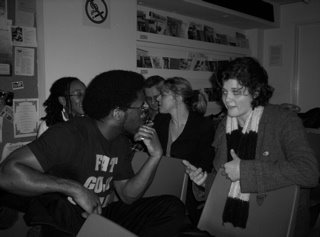
Jacob Sam-La Rose
My thanks to my husband Steve, who stoutly accompanied me down to London even though it meant he didn’t get to bed until nearly 3am and then had to get up for work again at 7am, and to my oldest and dearest friend Judy Ewart, who bought my train ticket, bless her, sat through the reading and then did something almost unheard-of at such events, and actually bought books by the other poets there. With hard cash!
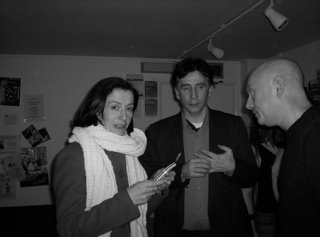
Martina Evans and Kevin Higgins (first from the left)
Yes, it was an enjoyable and fruitful evening; I’ve found that reading poems to an audience is essential for testing them on the air. Otherwise you’re only hearing the poems inside the space of your own head, or as a private exchange between yourself and maybe your partner or husband or cat, whoever happens to be listening when you first try them aloud, and it can be harder to spot glitches in the rhythm or words which don’t fit as perfectly as they should. So it was a useful exercise and I did take away some thoughts on possible structural changes to the more recent poems. I also noted which poems seemed to ‘grip’ the audience more than others.
To my mind, no sin in a writer is greater than that of boring the reader/listener. So it’s a relief to find a poem within your repertoire that, like a good and trusted friend, can be relied upon in almost all circumstances; a muscular sort of poem with broad shoulders and, even better, deep pockets.
I only discovered BUFFY a couple of years back, having married a serious sci-fi/fantasy/horror fan, and now I have the pleasure of steadily watching my way through both BUFFY and ANGEL on DVD, courtesy of the incredibly good value home rental system on amazon. I find both highly entertaining. Especially when laid low and in desperate need of some eye-candy, as the Americans would put it. I’m referring, of course, to the sultry David Boreanaz, who plays Angel, the vampire with a soul.
So, I did my Fourcast reading at the Poetry Cafe last week and it went very well. I was nervous up until the last minute, then found it easy to slide back into performance mode. The poems I read were all new, i.e. uncollected, and some were so new they haven’t yet found their way into any magazines. I was very impressed by Martina Evans, Kevin Higgins and Jacob Sam-La Rose, the other poets reading with me that night, and it was good to see Roddy Lumsden again, who was hosting the event.
Jacob Sam-La Rose
My thanks to my husband Steve, who stoutly accompanied me down to London even though it meant he didn’t get to bed until nearly 3am and then had to get up for work again at 7am, and to my oldest and dearest friend Judy Ewart, who bought my train ticket, bless her, sat through the reading and then did something almost unheard-of at such events, and actually bought books by the other poets there. With hard cash!

Martina Evans and Kevin Higgins (first from the left)
Yes, it was an enjoyable and fruitful evening; I’ve found that reading poems to an audience is essential for testing them on the air. Otherwise you’re only hearing the poems inside the space of your own head, or as a private exchange between yourself and maybe your partner or husband or cat, whoever happens to be listening when you first try them aloud, and it can be harder to spot glitches in the rhythm or words which don’t fit as perfectly as they should. So it was a useful exercise and I did take away some thoughts on possible structural changes to the more recent poems. I also noted which poems seemed to ‘grip’ the audience more than others.
To my mind, no sin in a writer is greater than that of boring the reader/listener. So it’s a relief to find a poem within your repertoire that, like a good and trusted friend, can be relied upon in almost all circumstances; a muscular sort of poem with broad shoulders and, even better, deep pockets.
Tuesday, December 13, 2005
Poetry Cafe reading this Thursday at 8pm
This is just a reminder that I'll be reading in London this Thursday from 8pm, at the Poetry Cafe, 22 Betterton Street, near Covent Garden.
Poets also on the 'menu' that evening will be Martina Evans, Jacob Sam-La Rose and Kevin Higgins. It's a fiver to get in, £4 concessions, with Roddy Lumsden hosting the event.
Poets also on the 'menu' that evening will be Martina Evans, Jacob Sam-La Rose and Kevin Higgins. It's a fiver to get in, £4 concessions, with Roddy Lumsden hosting the event.
Sunday, December 11, 2005
'Ratified': a poetry collection from the author of 'The Ropemaker's Daughter'

'The Alchemy of the Unexpected'
Novelist, poet and librarian Virginia Warbey died tragically young in a car crash in June 2004. Probably her best-known works are still her novels; The Ropemaker’s Daughter and The Carradine Diary, both published by Diva under her married name Virginia Smith, now modern classics of lesbian literary fiction. But a second collection of her poetry, entitled RATIFIED, has been published posthumously and when it came into my possession at the recent Torbay Poetry Festival, it took only a quick glance through its 80-odd pages to leave me determined to review it.
Poet Vicki Feaver has praised Warbey’s poetry, saying: ‘These are poems ... with a distinct voice and style: love poems that reinvent the love poem, ‘make it new’, as is the gifted poet’s task.’ I agree with this, and would add that it is Warbey’s ability to achieve such an intensely intimate tone in her love poems that makes her best pieces so memorable. One of the strongest instances of this is 'David and Bathsheba', a love poem that sidesteps the obvious problems attached to depicting such a well-known biblical couple, written with a rich attention to detail yet without sentimentality, seen with an artist’s eye and described with a poet’s ear:
'I was lost the first night I saw her,
kneeling at the courtyard pool, her skirts
gathered about her waist,
cypress oil threading gold across her breasts;
a web of want to hook the heart of a king.
She came when I summoned her.
She lay with me,
and the radiance that spilled into the space
between our bodies
dazzled into dust the yoke of our vacuous pasts'
Displaying an innate ability to ‘close’ a poem succinctly and with an echoing resonance that sticks in the mind long after the book has been closed, Warbey ends the poem:
'for we have tasted God on each other’s lips,
Bathsheba and I, sharp as poison.
We arise each day from a sleep like death,
and drink again.'
This is a collection redolent with such biblical keynotes, either quick passing references - ‘a little Lazarus, unsteady on his feet’, for instance, in a poem about a favourite cat who ran out of lives - or stories lifted whole from the scriptures and lived in, inhabited by the poet until they have been made ‘new’, as Feaver put it, reinvented in Warbey’s own voice and idiom.
'Cedarwood' is written in Joseph’s voice, the young carpenter tormented by the thought of his wife Mary’s pregnancy by another man, as he supposes:
'I watch you through the window as I work.
I watch you at the well and in your father’s house.
You stoop down and your blue skirts crumple against your skin,
sticking to your thighs in the fly-blown heat.
You lift yourself carefully these days.
The cedarwood grows warm beneath
my hands, begins to darken.'
Similarly, 'The Wedding at Cana' is seen through the eyes of a wedding guest, particularly astonished by Jesus’ transformation of the water into wine since he was ‘The man I’d barely noticed. / The one least likely.’ This, Warbey argues, is ‘what it’s like sometimes’ - 'the alchemy of the unexpected’ - where the one least likely to change your life is often the one who is most able to do so.
This note in her poetry, an easy conversational tone which nonetheless manages to maintain rhythm and tension, is what best characterises Warbey’s work. The voices change, may rise and fall, but they remain defiantly poetic, as here in 'Magdalen', where her ideologically provocative opening lines ‘If they tell you that it wasn’t love, / don’t believe them’ strike a colloquial note that are soon followed by the embarrassingly intimate and closely-observed
'I bathed his feet with the scent of tears,
touched my lips to the dust
that lived
in the veins of his ankles'
demonstrating why Virginia Warbey won no fewer than 13 competition prizes for poems in this second collection.
But perhaps that’s where I come to my only reservation about RATIFIED; too many of these pieces do read like competition poems. Well-written, yes, but perhaps a little too well-written and self-conscious to really lift the hairs on the back of the neck. Something deeper always seems to be being held back, smoothed over and planed down, hidden like Joseph’s frustration and jealousy in her poem 'Cedarwood'. Now and then it can be glimpsed, in the turn of a phrase or in a beautifully achieved image, almost ready to emerge but not quite, as though the poet is pacing herself, attempting to master the form that could contain her.
It’s a tragedy, of course, that Virginia Warbey will never be able to develop her work beyond this second collection, to transform herself into the accomplished and award-winning poet I have no doubt she would have become if she had lived. But what we do have in this promising second collection, RATIFIED, is a poetry worth turning to for its richness of imagery, its keen and questioning intelligence, and its strong rhythmic sensitivity; the poignant last snapshot of a talented poet, poised forever on the very brink of initiation.
........
To order a copy of RATIFIED by Virginia Warbey (Merdon Marque, December 2004) the price is £6.95, plus £1.00 UK post & packing. Send orders with cheques, made payable to Chandlers Ford Writers (VW poetry), to Claire Gradidge, 8 Forest Road, Hants, SO53 1LZ.
Alternatively, you can order online at amazon.co.uk
Wednesday, December 07, 2005
fine beards on display at the Night Blue Fruit poetry spot
It was the monthly Night Blue Fruit live poetry event last night and there was a packed house at the Tin Angel in Coventry. Pleasantly attended in the first half, elbow room only by the second half. Perhaps news had gone round that I was reading early. Jon Morley of the Heaventree Press kicked off the evening by reading a lively extract from David Dabydeen’s novel Our Lady of Demerara.
Hindu believe when you die you come back as ant, like me muma, or toucan like me dadee, or maybe a prince, a pandit, a pork-knocker, depending on whether Lord Krishna, who rule the universe, vex with you or content…
Heaventree Press published an extract from this novel in pamphlet form last year (entitled Jungle and available for £3.99 both from Heaventree Press itself and from Amazon).
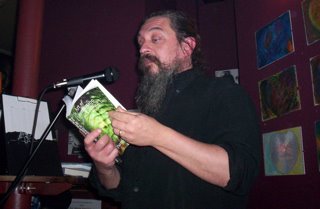
Then we heard from Colin Dick, seen below, whose complex poems, command of the English language and fine Old Testament beard continue to astound and fascinate us all.
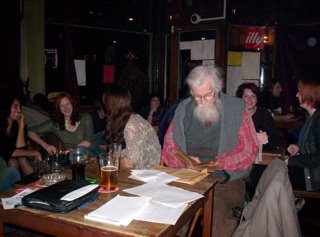
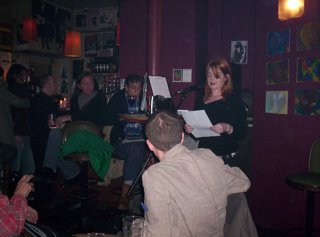
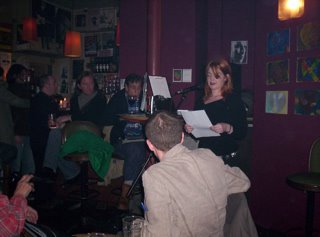
I read a handful of my own poems, talked to some interested parties about a possible Coventry Poetry Festival starting in 2007, and took these rather murky-looking photographs to capture the ambience. This is a young American poet, Deborah Adams, reading her poetry at the Tin Angel for the first time ... it can be a bit of a bear pit, but we took her innocence into consideration and were kind. I decided to post her photograph on here as a sort of odd-one-out situation; i.e. she didn't have a beard.
And here’s Barry Patterson, local poet and professional performer, putting in a quick plug for his newly published book, The Art of Conversation with the Genius Loci, which ‘looks at the relationship between our spiritual path and our immediate environment’ in a powerful combination of prose and poetry.
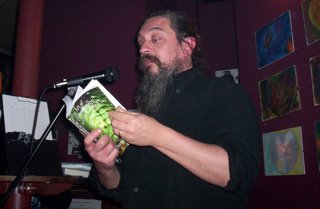
You can get hold of Barry Patterson’s book (£13.95) online from the publisher or by writing to
Capall Bann Publishing
Auton Farm
Milverton
Somerset TA4 1NE
And if all these beards and reading-your-own-poetry-to-an-audience craziness sound too exciting to miss, you can join Night Blue Fruit every month at the fabulous Tin Angel bar in Medieval Spon Street, Coventry, by clicking here for more details. You don't need to have a beard and it’s all free, except for the beer ...
Hindu believe when you die you come back as ant, like me muma, or toucan like me dadee, or maybe a prince, a pandit, a pork-knocker, depending on whether Lord Krishna, who rule the universe, vex with you or content…
Heaventree Press published an extract from this novel in pamphlet form last year (entitled Jungle and available for £3.99 both from Heaventree Press itself and from Amazon).
Then we heard from Colin Dick, seen below, whose complex poems, command of the English language and fine Old Testament beard continue to astound and fascinate us all.

I read a handful of my own poems, talked to some interested parties about a possible Coventry Poetry Festival starting in 2007, and took these rather murky-looking photographs to capture the ambience. This is a young American poet, Deborah Adams, reading her poetry at the Tin Angel for the first time ... it can be a bit of a bear pit, but we took her innocence into consideration and were kind. I decided to post her photograph on here as a sort of odd-one-out situation; i.e. she didn't have a beard.
And here’s Barry Patterson, local poet and professional performer, putting in a quick plug for his newly published book, The Art of Conversation with the Genius Loci, which ‘looks at the relationship between our spiritual path and our immediate environment’ in a powerful combination of prose and poetry.
You can get hold of Barry Patterson’s book (£13.95) online from the publisher or by writing to
Capall Bann Publishing
Auton Farm
Milverton
Somerset TA4 1NE
And if all these beards and reading-your-own-poetry-to-an-audience craziness sound too exciting to miss, you can join Night Blue Fruit every month at the fabulous Tin Angel bar in Medieval Spon Street, Coventry, by clicking here for more details. You don't need to have a beard and it’s all free, except for the beer ...
Sunday, December 04, 2005
Night Blue Fruit at the Tin Angel, 6th December
For those living in the Midlands, the next Night Blue Fruit live poetry event will be held this Tuesday, 6th December, at the highly atmospheric Tin Angel in Medieval Spon Street, Coventry. Hosted as always by Jon Morley of the Heaventree Press, the evening tends to kick off at about 8.30pm. Best to turn up a little earlier though to make sure of an open mic slot.
If you’ve never been before, it’s a lively and informal evening in a superb venue, well worth a visit if you’re into live poetry. Listen or join in, it’s entirely up to you. It's free, and there’s a fully licensed bar!
I’ll be at the Tin Angel this month too, reading some new work from 8.30pm onwards. Perhaps trying out some pieces I intend to read in London on Thursday 18th, at the Poetry Society Fourcast gig. And talking to people about the possibility of launching a Coventry Festival.
There seems to be such a strong poetic vibe in Coventry these days, with the Heaventree Press making strides with new and challenging publications, and our live poetry events always so packed out. It feels like time we thought about expanding our horizons and inaugurating an international poetry or literary festival in the city that would attract readers, performers, listeners and writers from all over the world.
If you’ve never been before, it’s a lively and informal evening in a superb venue, well worth a visit if you’re into live poetry. Listen or join in, it’s entirely up to you. It's free, and there’s a fully licensed bar!
I’ll be at the Tin Angel this month too, reading some new work from 8.30pm onwards. Perhaps trying out some pieces I intend to read in London on Thursday 18th, at the Poetry Society Fourcast gig. And talking to people about the possibility of launching a Coventry Festival.
There seems to be such a strong poetic vibe in Coventry these days, with the Heaventree Press making strides with new and challenging publications, and our live poetry events always so packed out. It feels like time we thought about expanding our horizons and inaugurating an international poetry or literary festival in the city that would attract readers, performers, listeners and writers from all over the world.
Wednesday, November 30, 2005
a white Christmas?
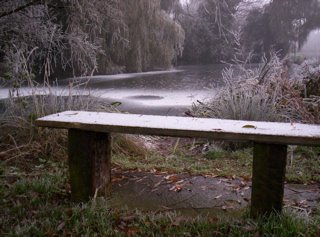
I took this last week in the Warwickshire village near my home. Beautiful, isn't it? I almost expected to see the odd duck frozen solid in the pond, maybe just its head sticking out. And then the snow came. For a while it seemed as though my dire warnings of a mini Ice Age were not so far-fetched after all. But the snow began to thaw quite rapidly and is now just a vague iciness clinging to the hedgerows. Well, this is Warwickshire. Not the Orkneys. Though I think the kids would have liked the snow to stick around a little longer.
Quite a few of my posts seem to be about the weather recently. Hmm. It's all very British of me, but perhaps I should try and make my next post about poetry instead. Just to keep up appearances.
Here are my twin sons, three years old, out in the recent snow.

Monday, November 28, 2005
THANATOS: the death-instinct
When I first started this blog, I thought it would be nice to post up some poems from time to time, but never really got around to managing that. But being deeply involved with a new novel at the moment, it seems a quick way of keeping the blog active without having to bare my soul online.
This isn't a new poem but it is one of my personal favourites. I wrote THANATOS in about 1998; it was published a year or so later in PN Review, an intelligent poetry magazine edited by Michael Schmidt of Carcanet Press (PN stands for Poetry Nation). Since my second collection is still forthcoming, it has not yet been published in book form.
It's never easy for a poet to 'explain' a poem they have written, but THANATOS, I suppose, is a poem which likens love to being caught in a cyclone. It's quite different from the poems in my first collection, most notably in terms of form; I'd been reading some of Ted Hughes' later work when I wrote this - his BIRTHDAY LETTERS, in particular - and I was rather taken with the prosiness (which I'm not convinced is a real word) and dramatic tone of that collection.
Thanatos comes from the Greek for death. I think it means something like 'death-instinct' - at least, that's what I took it to mean at the time I wrote this poem. Later, I agreed to medication and am no longer driven to write this sort of grim, self-involved poetry. I'm not sure if that's entirely a good thing. I prefer compulsive poetry to light anecdotal verse, and it's quite hard to write poetry of a compulsive nature when everything's sunny in your life and you're not struggling with some terrible inner demon. Though I imagine there are many poets out there who would - and probably will - disagree with that particular generalisation. Fortunately, I don't care.
THANATOS
Schoolgirl vulnerable, still smarting from
the fumbled mismatch of a love affair, I fell
straight out of space and into hell
that night. He was only a voice
on the edge of nothing, but I kept returning
to him, flickering like a stilled film
against the mindless black ferocity of wind.
The roof was trying to suck me out, vast mouth
clamped like a mad baby’s over the breast
of a house, whining for milk. I wanted
then to loose my hold, know how it feels
to spiral in the infinite, to Catherine-wheel
across the space that once was love.
Thanatos, pricking at my blood: the truth
that I came searching for, a weariness
that threatened to unclasp my hand, saying
it’s over, all over, why resist?
But at the other end of light, the funnelled dark
was a dead body I clung to out of
sheer stubbornness.
And the black wind
could not dislodge me from my welding-place,
though its eye bent in and saw me there,
plucked at my white knuckles, severed
the electric umbilical of light. I took
that place and hid it underneath the other times,
less brutal, more arranged. But it comes back,
obliterates that flash between dark and dawn,
and I pretend not to recognise it; call it
desire for solitude. Expurgate, disown the truth.
This isn't a new poem but it is one of my personal favourites. I wrote THANATOS in about 1998; it was published a year or so later in PN Review, an intelligent poetry magazine edited by Michael Schmidt of Carcanet Press (PN stands for Poetry Nation). Since my second collection is still forthcoming, it has not yet been published in book form.
It's never easy for a poet to 'explain' a poem they have written, but THANATOS, I suppose, is a poem which likens love to being caught in a cyclone. It's quite different from the poems in my first collection, most notably in terms of form; I'd been reading some of Ted Hughes' later work when I wrote this - his BIRTHDAY LETTERS, in particular - and I was rather taken with the prosiness (which I'm not convinced is a real word) and dramatic tone of that collection.
Thanatos comes from the Greek for death. I think it means something like 'death-instinct' - at least, that's what I took it to mean at the time I wrote this poem. Later, I agreed to medication and am no longer driven to write this sort of grim, self-involved poetry. I'm not sure if that's entirely a good thing. I prefer compulsive poetry to light anecdotal verse, and it's quite hard to write poetry of a compulsive nature when everything's sunny in your life and you're not struggling with some terrible inner demon. Though I imagine there are many poets out there who would - and probably will - disagree with that particular generalisation. Fortunately, I don't care.
THANATOS
Schoolgirl vulnerable, still smarting from
the fumbled mismatch of a love affair, I fell
straight out of space and into hell
that night. He was only a voice
on the edge of nothing, but I kept returning
to him, flickering like a stilled film
against the mindless black ferocity of wind.
The roof was trying to suck me out, vast mouth
clamped like a mad baby’s over the breast
of a house, whining for milk. I wanted
then to loose my hold, know how it feels
to spiral in the infinite, to Catherine-wheel
across the space that once was love.
Thanatos, pricking at my blood: the truth
that I came searching for, a weariness
that threatened to unclasp my hand, saying
it’s over, all over, why resist?
But at the other end of light, the funnelled dark
was a dead body I clung to out of
sheer stubbornness.
could not dislodge me from my welding-place,
though its eye bent in and saw me there,
plucked at my white knuckles, severed
the electric umbilical of light. I took
that place and hid it underneath the other times,
less brutal, more arranged. But it comes back,
obliterates that flash between dark and dawn,
and I pretend not to recognise it; call it
desire for solitude. Expurgate, disown the truth.
Tuesday, November 22, 2005
Fourcast: London reading next month
For those in the London area who have never heard me perform and can stomach the thought, I’ll be in the capital next month reading a selection of my new poems, alongside poet and novelist Martina Evans, Salmon Poet Kevin Higgins and Jacob Sam-La Rose, as part of the FourCast series at Covent Garden.
FourCast is a series of poetry readings held each month downstairs at the Poetry Society's headquarters in London, otherwise known as the Poetry Studio, hosted by the Scottish poet & writer Roddy Lumsden. Hope to see you there!
DETAILS:
Venue: Poetry Cafe, 22 Betterton St, Covent Garden, London
Date/Time: Thursday 15th December, 7.30pm
Tickets: £5/£4
FourCast is a series of poetry readings held each month downstairs at the Poetry Society's headquarters in London, otherwise known as the Poetry Studio, hosted by the Scottish poet & writer Roddy Lumsden. Hope to see you there!
DETAILS:
Venue: Poetry Cafe, 22 Betterton St, Covent Garden, London
Date/Time: Thursday 15th December, 7.30pm
Tickets: £5/£4
Friday, November 18, 2005
Aren't men thoughtful?
My husband very kindly took me out to dinner for my birthday treat last night. We went in my car, with him behind the wheel for once so I could legally down a couple of glasses of Chardonnay. When I struggled into the car this morning after some vigorous de-icing - it looked like a wedding cake on wheels - I discovered that I was almost out of petrol. Picture this. It’s the nursery school run. You have three children under four years old in the car and a trip of over 9 miles to the nearest petrol station, with the needle well into the red and the warning light glaring at you the whole way. What joy. Luckily, I just made it, coasting most of the way on fumes. Harumph.
Thursday, November 17, 2005
BBC Radio Coventry and Warwickshire

Took this photograph in my back garden at 7.30am this morning, here in frosty Warwickshire, where the surrounding fields were as white as the sheep in them until about 9am when the bright sunshine finally thawed them out.
And it’s my birthday today! Seventeen again. That’s how old I feel when I’m lying down. Standing up is another matter. I got Swiss chocolates, After Eight mints, bubble bath, an electric toothbrush (for use after the chocolates, I suspect) and a new DVD of the 1995 BBC production of Persuasion, which is my favourite among Jane Austen’s novels, superbly cast and directed, starring Amanda Root and Ciaran Hinds with screenplay by Nick Dear. Thanks for that, dear husband and assorted children. And as for the cheque from my aged paternal relative, now residing on the continent, many astonished thanks too. At last I can afford Mark Haddon’s debut poetry collection, whose title is too long to remember and which costs about £12 - published in hardback, I think - which has put it just out of my financial reach until now.
Mmm. I feel a review coming on in the near future ...
This week, I was invited to do a live interview with Anita Miah on BBC Radio Coventry & Warwickshire. I’ve been down to their studios before, they’ve got these amazing new premises in the centre of Coventry, down in Priory Place just below the Cathedral. The whole square there has been superbly revamped; it’s now a sort of Little London tucked away behind the shopping centres and pubs, with some rather expensive-looking wine bars and bistros, outside seating during the summer, a beautiful water feature complete with waterfall and atmospheric night lights, and the BBC building right there at the heart of it. So I left the sheep fields behind last night and drove into Coventry to read some of my poetry and chat about my writing career with Anita Miah. It was a good interview, very relaxed and fun. If you managed to catch any of it, do let me know by leaving a comment on this site.
Continuing with the poetry theme, for those in the London area, the Poetry Society would like to remind everyone about the reading tonight with Tomaz Salamon and Gregor Podlogar at 7.30pm in the Poetry Studio at 22 Betterton Street (Covent Garden tube is closest, I seem to recall). The event will be introduced by Fiona Sampson and Stephen Watts will be one of the English readers of their poems. This is a free event sponsored by the Slovenian government. So there you have it. Free poetry!
Sunday, November 13, 2005
se Googler = to self-Google?
Whilst looking myself up on Google tonight - an occasional ego-trip which always seems to leave me depressed - I stumbled across a link to Martin Blyth's website where anyone who wants a laugh will find an extremely unflattering photograph of me sporting what appears to be a double chin, plus a far more comprehensive account of the recent Torbay Poetry Festival than the one I posted below. I did manage to rub a few words together with Martin while I was in Torquay but somehow we never quite sat down together for a proper conversation about poets and poetry. Next time, perhaps. Meanwhile, I highly recommend his site for a poetry-related cyber jump. Just click Enter once there and follow the site guide to Torbay.
Friday, November 11, 2005
break out the champagne!
At long last, the book I have been writing for nearly a year is finished! Well, more or less finished. The last page has been written but there's still a little fine-tuning to be done before I can shoot it off in the post. Polishing. Editing. Revising. Perhaps the odd name change. That sort of thing. It's a fantasy novel for children, that's as much as I'm prepared to say about it at the moment. But I'm extremely pleased and relieved that it's almost ready to be seen.
Now I can get on with the other novel that's been bugging me for months now, desperate to interfere with the one I've just finished. Almost finished. Still, finished or almost finished, it's definitely time to unwind for a few hours. Glass in one hand, rough draft of a synopsis for my next novel in the other ...
Now I can get on with the other novel that's been bugging me for months now, desperate to interfere with the one I've just finished. Almost finished. Still, finished or almost finished, it's definitely time to unwind for a few hours. Glass in one hand, rough draft of a synopsis for my next novel in the other ...
Monday, November 07, 2005
milk comes frozen home in pail
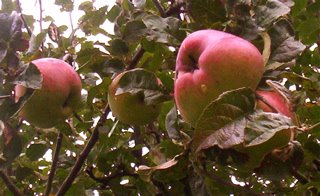
I took this picture some weeks ago in my back garden, here in rural Warwickshire, Shakespeare country, but there are still apples on this tree even now, too high to be picked without a ladder. The squirrels are enjoying them, and a few late wasps. Apples on the trees? Wasps still active in November? It's lovely that the autumn has been so mild here. But I find the unpredictable weather in recent years both mystifying and worrying.
In fact, I've been doing quite a bit of reading on climate change over the past few weeks, mainly because I'm researching a story I want to set in the mid-seventeenth century and have discovered (I had never been aware of this before, to my shame) that we experienced a Little Ice Age for about 150 years, dating from roughly the time of Shakespeare's birth through to the early 1700s. Then I remembered Shakespeare' s 'milk comes frozen home in pail' from Love's Labour's Lost, Act 5. As a child, I always thought this description of winter a little exaggerated; now I realise that the icy winters of the late 16th and 17th centuries would have been a great deal harsher than our own mild frosts, with snow remaining on the ground some years for as long as a hundred days and Ice Fairs held on the Thames throughout the winter:
When icicles hang by the wall
And Dick the shepherd blows his nail
And Tom bears logs into the hall
And milk comes frozen home in pail,
When blood is nipp'd and ways be foul,
Then nightly sings the staring owl: Tu-whit,
Tu-who, a merry note,
While greasy Joan doth keel the pot.
When all aloud the wind doth blow
And coughing drowns the parson's saw
And birds sit brooding in the snow
And Marian's nose looks red and raw,
When roasted crabs hiss in the bowl,
Then nightly sings the staring owl: Tu-whit,
Tu-who, a merry note,
While greasy Joan doth keel the pot.
The problem is, research has shown that if the deep ocean currents that keep our climate stable are eventually overwhelmed and changed by the rapid and ongoing melting of polar ice, another Ice Age could occur within the space of a few short years - not gradually, over a hundred years, as was previously thought. And there's nothing to suggest that it would be as short a cold snap as Shakespeare's Little Ice Age. Some experts believe it could last for hundreds of thousands of years.
Time, perhaps, for us to take global warming and anti-pollution measures seriously. The links I've used here are only the tip of the iceberg; try googling Ice Age and see what you come up with.
Saturday, November 05, 2005
Moira's debate speech at the Torbay Festival 2005
Below is the transcript of Moira Clark's opposing speech in the Torbay Poetry Festival debate 'Is poetry just another form of therapy?' I'm afraid I don't have the transcript of Geoffrey's speech to set against this, but I hope anyone who feels strongly either way will read this post and make their comments below! Moira won the debate -- scroll back a few posts to read my account of the Torbay Poetry Festival itself for further details and photographs. Delivered at the Belgrave Hotel, Torquay, on Saturday October 22nd. The proposer was Geoffrey Godbert IS POETRY JUST ANOTHER FORM OF THERAPY? with opposing speech here below by Moira Clark.
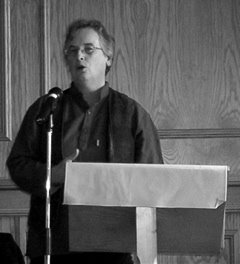
'Poetry is just another form of therapy? I think we have to look at the words in this sentence in order to understand how to address it. Poetry. What is poetry? We could debate this for ever but that’s not the issue here. Let’s look at what poets say about poetry since I’m sure therapists are not the best people to ask. As poets, we all know this quote by Coleridge: 'Poetry; the best words in the best order.' And TS Eliot: 'Genuine poetry can communicate before it is understood.' Emily Dickinson: 'If I feel physically as if the top of my head were taken off, I know that is poetry.' And Christopher Logue (the chap who is trying to translate Homer’s Illiad): 'Poetry cannot be defined, only experienced.' 'Poetry is. A poem should not mean. But be.' Archibald MacLeish.
So poetry is not a way of healing ourselves. It is about the best words in the best order, communication, a physical decapitation and an experience. I have been amazed by the number of poets who say they didn’t find their way to poetry; poetry chose them: Dannie Abse, Maura Dooley. So if it isn’t a matter of choice, what is it? Just another form of therapy?
Just in this context means: at most, merely, no more than, nothing but, only, simply, solely. So it might read: poetry is only another form of therapy. There are no arguments that poetry has been used to help people through crises of mental and physical distress but surely poets are not all depressed, psychotic, or suicidal. But is poetry simply, solely, merely and nothing more than another form of therapy? If that has become a truism, then I am in the wrong business; along with Jo Shapcott who says: 'Poems are for exploration, discovery, transformation. They would be very dull otherwise. The idea of poetry primarily for therapy is pretty pointless.' And Neil Astley, that champion of getting poetry to everyone, says: 'Good poetry doesn’t offer a simple solace or poetic medication; it opens up the senses, it disturbs, questions, challenges.'
So… to therapy. By definition: Therapy is the remedial treatment of illness or disability. So is poetry a cure-all? I don’t think so. How many of you have expected poetry to cure you when you’ve been ill, had a broken leg? When your leg is broken you don’t go to a physiotherapist and ask them how to express your pain and anger at having to sit around the house waiting for your bones to heal. We wouldn’t go for radiation therapy and ask if the writing of a poem would put our cancer into remission. Poets of the First W.W. had to find strategies for dealing with that experience and were the first to articulate the fact that war was not what people at home imagined. Was Wilfred Owen using poetry as a means of therapy – to get him through the war - or was he trying to get across the awfulness of war to those who weren’t experiencing it first hand? In Dulce et Decorum, he writes:
Bent double, like old beggars under sacks,
Knock-kneed, coughing like hags, we cursed through sludge,
Till on the haunting flares we turned our backs
And towards our distant rest began to trudge.
Men marched asleep. Many had lost their boots
But limped on, blood-shod. All went lame; all blind;
Drunk with fatigue; deaf even to the hoots
Of tired, outstripped Five-Nines that dropped behind.
This is not written with therapeutic intent.
If poetry is just another form of therapy does it mean that all poets are continuously trying to heal themselves? That would mean that we poets are a sorry bunch indeed. We are all troubled with deep depression, in constant pain and so we need to write poems to heal ourselves. What bloody nonsense! Undeniably there are poets who have written out of a place of depression, of mental illness but their intention was not primarily one of self therapy but rather to express their experiences – to translate them into poetry. I’m thinking particularly of Anne Sexton, Sylvia Plath and John Berryman.
Kate Foley says: 'Poetry is not a therapeutic process. It isn’t about the healing that can take place in therapy. It’s about selecting, reflecting, ordering, and, if you’re lucky, making art and making sense.' So poetry is about selecting the best words, using them in the best order. It’s about making art: 'Painting is silent poetry, and poetry is painting with the gift of speech,' says Simonides – one of the most prolific poets of ancient Greece. And 'Poetry is the impish attempt to paint the colour of wind': Maxwell Bodenheim.
Surely this is the next step we must take. Poetry isn’t just an outpouring of emotion – it’s a craft, an art. It’s the attempt to ‘paint the colour of wind’. I’d have given up long ago if I could only read confessional poems from depressed, psychotic suicides. I would guess that everyone in this room would have lost interest if all the poetry in the world was about depression, sorrow and woe, woe is me! Maura Dooley says: '…the ‘I’ in a poem is imagined or borrowed not simply me. Like looking at the over-familiar and making it new again, making it strange. Isn’t that always one of poetry’s greatest strengths? It would be boring of me to write about my personal sorrows.'
Yes. Yes. Yes. It would be boring to read about people’s personal sorrows especially if they were using poetry – an art, a craft which opens up the senses, questions, challenges, puts the best words in the best order – as some kind of therapy without addressing the reader or the listener. An outpouring of pain is not poetry. And poetry is not just another form of therapy. It’s so much more. UA Fanthorpe says: 'It’s important to admit your fears. But the most important thing is to survive and you can’t survive if you’re eaten up by terror.' She also says: 'A poem is the conversation between the poet and the reader.' A therapeutic poem would be a one-way thing – not a conversation.
So how can anyone argue that 'poetry is just another form of therapy' when there is so much evidence to suggest it’s far from that? The point of poetry, Paul Muldoon says, is 'to be acutely discomforting, to prod and provoke, to poke us in the eye, to punch us on the nose, to knock us off our feet, to take our breath away.' If Paul Muldoon is right then it’s far from being therapeutic.
Poetry is. Poetry is communication, language, conversation. It disturbs, challenges, questions, explores. It is about making art, making sense. Poetry can attempt to paint the colour of the wind. Poetry can console, uplift, encourage, provide new insights. But, poetry cannot cure. It cannot stop us committing suicide. It cannot put our cancers in remission. It cannot mend a broken leg. Poetry cannot be the remedial treatment of illness or disability. Poetry is not just another form of therapy.'
Moira Clark, October 2005
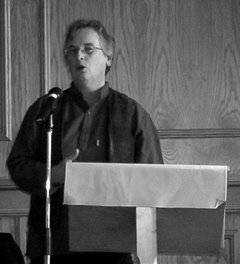
'Poetry is just another form of therapy? I think we have to look at the words in this sentence in order to understand how to address it. Poetry. What is poetry? We could debate this for ever but that’s not the issue here. Let’s look at what poets say about poetry since I’m sure therapists are not the best people to ask. As poets, we all know this quote by Coleridge: 'Poetry; the best words in the best order.' And TS Eliot: 'Genuine poetry can communicate before it is understood.' Emily Dickinson: 'If I feel physically as if the top of my head were taken off, I know that is poetry.' And Christopher Logue (the chap who is trying to translate Homer’s Illiad): 'Poetry cannot be defined, only experienced.' 'Poetry is. A poem should not mean. But be.' Archibald MacLeish.
So poetry is not a way of healing ourselves. It is about the best words in the best order, communication, a physical decapitation and an experience. I have been amazed by the number of poets who say they didn’t find their way to poetry; poetry chose them: Dannie Abse, Maura Dooley. So if it isn’t a matter of choice, what is it? Just another form of therapy?
Just in this context means: at most, merely, no more than, nothing but, only, simply, solely. So it might read: poetry is only another form of therapy. There are no arguments that poetry has been used to help people through crises of mental and physical distress but surely poets are not all depressed, psychotic, or suicidal. But is poetry simply, solely, merely and nothing more than another form of therapy? If that has become a truism, then I am in the wrong business; along with Jo Shapcott who says: 'Poems are for exploration, discovery, transformation. They would be very dull otherwise. The idea of poetry primarily for therapy is pretty pointless.' And Neil Astley, that champion of getting poetry to everyone, says: 'Good poetry doesn’t offer a simple solace or poetic medication; it opens up the senses, it disturbs, questions, challenges.'
So… to therapy. By definition: Therapy is the remedial treatment of illness or disability. So is poetry a cure-all? I don’t think so. How many of you have expected poetry to cure you when you’ve been ill, had a broken leg? When your leg is broken you don’t go to a physiotherapist and ask them how to express your pain and anger at having to sit around the house waiting for your bones to heal. We wouldn’t go for radiation therapy and ask if the writing of a poem would put our cancer into remission. Poets of the First W.W. had to find strategies for dealing with that experience and were the first to articulate the fact that war was not what people at home imagined. Was Wilfred Owen using poetry as a means of therapy – to get him through the war - or was he trying to get across the awfulness of war to those who weren’t experiencing it first hand? In Dulce et Decorum, he writes:
Bent double, like old beggars under sacks,
Knock-kneed, coughing like hags, we cursed through sludge,
Till on the haunting flares we turned our backs
And towards our distant rest began to trudge.
Men marched asleep. Many had lost their boots
But limped on, blood-shod. All went lame; all blind;
Drunk with fatigue; deaf even to the hoots
Of tired, outstripped Five-Nines that dropped behind.
This is not written with therapeutic intent.
If poetry is just another form of therapy does it mean that all poets are continuously trying to heal themselves? That would mean that we poets are a sorry bunch indeed. We are all troubled with deep depression, in constant pain and so we need to write poems to heal ourselves. What bloody nonsense! Undeniably there are poets who have written out of a place of depression, of mental illness but their intention was not primarily one of self therapy but rather to express their experiences – to translate them into poetry. I’m thinking particularly of Anne Sexton, Sylvia Plath and John Berryman.
Kate Foley says: 'Poetry is not a therapeutic process. It isn’t about the healing that can take place in therapy. It’s about selecting, reflecting, ordering, and, if you’re lucky, making art and making sense.' So poetry is about selecting the best words, using them in the best order. It’s about making art: 'Painting is silent poetry, and poetry is painting with the gift of speech,' says Simonides – one of the most prolific poets of ancient Greece. And 'Poetry is the impish attempt to paint the colour of wind': Maxwell Bodenheim.
Surely this is the next step we must take. Poetry isn’t just an outpouring of emotion – it’s a craft, an art. It’s the attempt to ‘paint the colour of wind’. I’d have given up long ago if I could only read confessional poems from depressed, psychotic suicides. I would guess that everyone in this room would have lost interest if all the poetry in the world was about depression, sorrow and woe, woe is me! Maura Dooley says: '…the ‘I’ in a poem is imagined or borrowed not simply me. Like looking at the over-familiar and making it new again, making it strange. Isn’t that always one of poetry’s greatest strengths? It would be boring of me to write about my personal sorrows.'
Yes. Yes. Yes. It would be boring to read about people’s personal sorrows especially if they were using poetry – an art, a craft which opens up the senses, questions, challenges, puts the best words in the best order – as some kind of therapy without addressing the reader or the listener. An outpouring of pain is not poetry. And poetry is not just another form of therapy. It’s so much more. UA Fanthorpe says: 'It’s important to admit your fears. But the most important thing is to survive and you can’t survive if you’re eaten up by terror.' She also says: 'A poem is the conversation between the poet and the reader.' A therapeutic poem would be a one-way thing – not a conversation.
So how can anyone argue that 'poetry is just another form of therapy' when there is so much evidence to suggest it’s far from that? The point of poetry, Paul Muldoon says, is 'to be acutely discomforting, to prod and provoke, to poke us in the eye, to punch us on the nose, to knock us off our feet, to take our breath away.' If Paul Muldoon is right then it’s far from being therapeutic.
Poetry is. Poetry is communication, language, conversation. It disturbs, challenges, questions, explores. It is about making art, making sense. Poetry can attempt to paint the colour of the wind. Poetry can console, uplift, encourage, provide new insights. But, poetry cannot cure. It cannot stop us committing suicide. It cannot put our cancers in remission. It cannot mend a broken leg. Poetry cannot be the remedial treatment of illness or disability. Poetry is not just another form of therapy.'
Moira Clark, October 2005
Wednesday, November 02, 2005
T.S. Eliot Lecture
George Szirtes gives this year's T. S. Eliot Lecture on Tuesday 22 November 2005 at 7.45pm in the Purcell Room at the South Bank Centre. Tickets £8.50. To book call 08703 800 400 or visit rfh.
Subscribe to:
Posts (Atom)