Showing posts with label women poets. Show all posts

Friday, July 02, 2010

Mothers, wives, poets.


Horrified today to see, via Arc poet Jackie Wills' blog, that an 'unknown' - as Jackie puts it - American poet called Eleanor Ross Taylor has been recognised for her talent with the Ruth Lily Award.

What horrified me was not the poet herself, or her poetry, or indeed the award, but the apparent equanimity with which some people seem to accept without question the US critic Kevin Prufer's description of her work (taken from a recent blog entry on the NBCC Award shortlisted finalists):

Her speakers are most often mothers and wives thinking about their grown children, the complexities of marriage, and (increasingly in the later poems) their responsibilities to the dead and their own impending demise. Sometimes these voices emerge from an ostensible past, as in “My Grandmother’s Virginhood, 1879” or “Motherhood, 1880.” More often, they take place in an undefined domestic present.  Occasionally, they rise from more surprising places, as in “Kitchen Fable,” where the flatware itself takes on the consciousness of a frustrated wife.

Wow, and there I was thinking we'd got past the ludicrously sexist 'Look, a woman who writes about domestic issues! Quick, let's give her an award and encourage other women to steer clear of politics and the 'big' issues, and write about their children and husbands instead.'

Granted, for some women, writing about being a wife and mother is all they want to do as poets. And for some women, writing a poem about being a woman is a political act in itself.

But let's at least stop and examine why Eleanor Ross Taylor has been so suddenly plucked out of obscurity to be given this award, if it isn't to suggest - perhaps at a subliminal level - to female writers that good girls who keep their heads down and only write quiet, domestic poetry will be recognised for their modesty and humility in the end.

Even if it's only with a pat-on-the-head style encomium from some highly placed male critic.

Saturday, February 16, 2008

In Response to a Nude Photograph of Mina Loy, 1905

From a 1917 interview with Loy in the New York Evening Sun

I'm massively engaged with revisions to my third poetry collection, running up against a deadline, so the review I wished to publish on Raw Light today will have to wait a few more days until I have time to type it up.

Meanwhile, here's something for the weekend ...

The following poem, published in Boudicca & Co, discusses and celebrates the nude photograph I found online here of the experimental poet Mina Loy.

*

In Response to a Nude Photograph of Mina Loy, 1905

Women poets are not supposed to look like that,
did nobody tell you? The one
with the cigarette is bullish enough
but this, taken naked, face
against the wall with one arse cheek
suggestively raised
is the portrait of a muse, my dear.
In later years, your beauty was eclipsed by age.
Here your skin’s like frost, that white back
and hourglass waist
crying out to be marked, to be photographed.
Did it feel safer like this, turned away
in your nakedness,
to be stared at, lusted after?
‘Leave off looking to men to find out
what you are not,’ you said.
Then let me take you to to bed, Mina,
to the ostrich feather bed
of our imagination. There we’ll smoke
and make poetry all day, decadent
in our sticky love,
looking each other in the eye, drinking
each other’s blood
like tea from a china dish, steeped
in what it means to be us, spawning
our poems like fish.

*

And to end, here's a rather lovely rough draft of Mina Loy's poem Love Songs I (1915)

Monday, July 09, 2007

Does the Male Muse exist?

Tomorrow morning, Tuesday 10th July, from 11.30am - 12.00 noon, you can catch My Male Muse on Radio 4. In this potentially controversial programme, "poet Clare Pollard dispels the popular female image of a muse. She argues that men can also be a source of beauty and inspiration, and contradicts poet Robert Graves, who famously claimed that the male muse doesn't exist."

The programme is produced by Clare Pollard and Tamysn Challenger. Other poets taking part will be Eva Salzman, Catherine Smith, Annie Freud, Melanie Challenger and Penelope Shuttle.

And as if the excitement of finding so many women poets on Radio 4 at once wasn't enough for one week, you can also listen to Fiona Sampson, poet and editor of Poetry Review, on Woman's Hour, Thursday July 12th between 10am and 10.45.

On that programme, Fiona will be reading from her brand-new poetry collection, just out from Carcanet, entitled Common Prayer. The programme will also feature discussions on the dreadful problem of endometriosis and 'how to moan without losing friends and alienating people'.

It could be worth my while to listen just for that last piece alone ...

Wednesday, June 20, 2007

Paraphernalia by Joanne Limburg (Bloodaxe, 2007): a first sharp look

I still haven't finished that Polley review. It's not some gleaming epic. I just can't seem to get my thoughts about Little Gods into any sort of coherent shape at the moment. It's probably the house move looming, all the tedious arrangements I have to tackle, such as actually finding us somewhere to live. Right now, anything that takes me too far away from my desk is a complete pain in the fundament. And moving house certainly comes into that category.

However, I received a copy of Joanne Limburg's second collection with Bloodaxe today. It's entitled Paraphernalia and is a handsome book with a cheery-looking cover painting by Liz Knox, a domestic scene featuring a kitchen table, but one suggestive of clutter and disarray. I'll probably look at it again in some depth next month, when perhaps hidden virtues may be revealed, but on a first read-through the book has proved disappointing enough to merit comment straightaway.

If this was a first book, I might be inclined to say, well, these poems are rough around the edges and a little dull, but she's not untalented and will no doubt improve. But Joanne Limburg started writing poetry at roughly the same time as I did, about ten years ago. And, to complicate matters, 'Paraphernalia' is a Poetry Book Society Recommendation. Which leaves me utterly astonished, when I can find lines of the following standard throughout this collection:

Every two hours,
20 by cup,
a little of me,
a note on a chart.

This is from a poem called Milk, about expressing milk to breast-feed a baby. It is by no means an unusual example of Joanne Limburg's work, nor is that topic unusual in a collection dominated by highly personal and domestic poems written so flatly and repetitively that I wonder whether the PBS were looking at the same book.

Perhaps it's intended to be light or comic verse. That might be possible, though I didn't personally find any of these poems funny. But I find it hard to believe that this is meant to be comic verse, as Limburg's poems - especially as you move further into the book - seem pervaded by an ever-deepening sense of malaise and disconnection from reality.

I take no pleasure in not being able to praise this book. Normally I would sidestep the review rather than write something very superficial, feeling unable to say anything positive about the book. Some of you may even be surprised to learn that I no longer possess the same taste for the jugular that got me into so much trouble back in the nineties.

But not wishing to be unkind doesn't mean I can't question the bestowing of a PBS Recommendation on a collection as weak as this. I am a member of the PBS and I don't expect to pay them a tidy sum of money every year only to be sent 'recommended' books through the post which I would put back on the shelf in a bookshop. And, after all, their website declares that 'The PBS offers the best new contemporary poetry to its members.'

Now, I'm perfectly open to hearing opposing points of view about 'Paraphernalia': indeed, I would welcome a debate on the book's merits. And I understand that all these PBS choices must be personal - that's a given in a highly subjective field like poetry - but I'd still be interested to know which selecting poets approved so highly of the poems from which the following extracts are taken, and precisely why:


One trip to the bin is all he needs
to put the lid on a season of chaos.
Now tell me that isn't better! It's better.

(final stanza of 'The Man Who Tidied His Wife's Handbag')

*

I have no mind for anything
but you and the gunge in the sink.

(from 'Nimbostratus')

*

Of course I could still change things - get off this sofa
and, you know, really do something about it.

(from 'Bubble')

*

O Night and Silence
why should I complain?

For though I am empty, and pale as veal,
surely your servants are good.

(from 'Psalm')

*

Despite our attempts
to resolve this matter
you fail to give us
the right response.

We are forced
to take action.

Now we are coming
to cut off your phone
to cut off your power
to cut off your water
to sever your every connection.

(from ATTENTION!, the title underlined and in capitals, a poem 'generated' by unpleasant letters the poet received by mistake from a mobile phone company, which were then apparently 'blend[ed] with a Cherokee "Spell to Destroy Life"' to produce this poem: I apologise for not being able to slightly indent the final lines as they appear in the book)

*

We shall not win security
by offering vermin security.

Sit back. Relax. Our marshals are trained
to handle cabin security.

Through the hissing fast flow teat
he's drinking in security.

(from "Security!", which repeats this end rhyme pattern for 9 couplets, possibly a 'ghazal', possibly not. If anyone knows the correct name for this poetic form, please leave a comment below.)

*

There was a husband - I suppose he left.
Now I'm poor, and sad, and home with mother.
I trudge between my bedroom, and the toilet,
don't even go downstairs until it's late.
I can't be bothered working for my 'A' Levels,
but if I fail again they'll keep the baby.

(from 'Late', a poem of 7 stanzas in the same voice, which is so consistently flat and prose-like that it makes me wonder why Limburg would choose to include it in her collection and why her editor didn't intervene. Perhaps they thought the drearily PC subject matter was enough to warrant its inclusion.)

*

Yes: I use this service.
No: no contact at all.
Always the minimum payment.
My signal is faint to poor.

Often: I think it's important.
My skin is slightly dry.
Whichever is the softer.
Citrus is better than pine.

(from 'Respondent': the conceit is explained by the title. It's an old trick, not particularly amusing, and although I hear and cheerily applaud many similar poems every month from open mic poets, it's hardly the standard of work I expect from a PBS Recommended Bloodaxe collection. Or is it?)

*

I'll stop there. I've had personal contact with Joanne Limburg, who is a perfectly delightful person, and I genuinely wish her all the very best with her writing. I am also convinced that many people will be fans of her work, otherwise she would not have got this far.

But when I read new poetry - particularly, perhaps, when I read other women poets, who have so much lost time to make up - I look for the hard, the ambitious, the unusual, the challenging, the witty, the powerful, the undaunted. So I am naturally disappointed when I find a collection by a woman poet of reasonable prominence which has been singled out for praise as Limburg's Paraphernalia has, yet which appears to possess little to recommend itself beyond a certain wacky modern sensibility and a taste for quirky, repetitively rhymed poems - I counted six poems in total which use the same couplet and end rhyme pattern throughout, a trick which soon palls. Where is the challenge in all this, where is the ambition?

Let me be clear. I am not looking to be needlessly unpleasant here, to trash Joanne Limburg's latest collection for my own purposes. When I get a new book like this, I turn to it eagerly, hoping to be excited and inspired. I desperately want to find strong mainstream women poets with whom I can identify and from whom I can learn. The fact that I'm still struggling to do so after ten years in poetry is one of the quiet everyday despairs of my life. So when I implore women poets like Joanne Limburg to be more inventive, more ambitious and more creatively independent in their poetry, I am also reminding myself of the gap between my own aspirations and the reality of my work.

Monday, June 11, 2007

Beautiful Scary Darkness: Tamar Yoseloff's 'Fetch' (Salt Publishing, 2007)

Some poetry collections seem to meander in several directions at once, a loose hotchpotch of styles. Others stick to a party line, eyes fixed on a particular prize, accolade or literary coterie. Then there are those rare poetry collections, like Tamar Yoseloff’s Fetch, which seem both artful and true to life’s variety; bundled tightly together in this handsome book from Salt, the poems feel as real and atmospheric as your own memories, as here when she describes foraging for 'Fungi':

The smell -
wet anorak, fusty books, disturbed dust
of long unopened doors -
like the basement of your childhood,
beautful scary darkness.

Fetch is Tamar Yoseloff’s third collection. Her first collection Sweetheart (Slow Dancer Press 1998) was a PBS Special Commendation and won the Aldeburgh Festival Prize. American-born, she lives in London and is a tutor for the Poetry School. No stranger to the technical side of poetry, then. Nor to the idea of leitmotifs, which she uses to great effect in this latest collection.

The odd-sounding title, Fetch, is variously defined by Yoseloff as a stratagem; a trick; an artifice; the double of a living person; a wraith. Correspondingly, there are five sequenced poems here entitled ‘Fetch’, which, along with a series of woodcuts by Linda Karshan, mark off five divisions in the book. All five poems are quite similar in form and tone, with an other worldly quality, a film noir sensibility that stops just short of the reveal.

This film noir shiver is compounded by the narrative voice, which acts like a voice-over at times, an inclination towards metanarrative that makes me think of a screenwriter at work on a manuscript; sitting alone, maybe slumped over a desk in the early hours of the morning, she sends her character out into this darker world of the imagination, masterminding her every move, following the action as though with a hidden camera.

So the 'Fetch' sequence becomes a sort of poetic Chinatown, a world reeking of fear, suspense and erotic tension, yet highly aware of itself as it operates within that genre. Eventually, in a sinister fashion, the female ‘fetch’ of these poems begins to subtly take on the narrator’s appearance, to disobey orders, do her own thing, threatening to leave her creator behind.

My overriding impression when reading Fetch was a contradictory one of delicate craft combined with an over-saturation of the senses. Not an easy book to read in one sitting, but certainly one to return to, enjoying the smooth poetry of the middle sections, discovering dark corners and previously unseen footage.

Yoseloff’s lyrical gift comes to the fore primarily in strong, sensuous poems like ’Tiger‘, ’Vaporetto in Winter’, and the painterly ‘Interior with a Woman Playing the Virginals’. One short poem, 'Spring', is written ‘after Barbara Hepworth’, the talented British sculptor and artist who made her home at St. Ives in Cornwall. In 'Spring', the poet points to the complications of modern life, where ‘We pull strings/taut, construct ourselves, little puzzles’ - which sounds very like her poetry, with its intricately built walls and pyramids of sound and image. They are not forbidding places, though. Tamar Yoseloff is always inviting the reader beyond her artifical constructs into an interior where life continues just out of sight, real and intimate, yet still suggestive of some cinematic mise-en-scene, as here in the final lines of 'St. Ives':

From this window: curtains
partly drawn, the coffee in the mugs
stone cold, the tiny union jack
the only colours in the world.*

This restless connection with the visual - both filmic and from the world of art - is echoed throughout the collection. First, there is Tamar Yoseloff’s ability to pick out all this delicate imagery in painstakingly selected and placed words. Then there’s the matter of her framing references - the titles of these poems - which often reveal her inspirations. In ‘Portrait of a Couple Looking at a Turner Landscape’, she plays with structural echoes as she describes the damp-haired couple who ‘stand, not quite touching’, shifting the left-hand margin to accommodate ‘vast plains of emerald and gold’ in the painting, employing the theatrical aside of parenthesis, her lines held in exquisite tension until the final climactic ‘the sky opens and it pours’.

Elsewhere, a poem called ‘Marks’ gets full ones from me. Reminiscent of Pauline Stainer’s best work, this long sequence glows with medieval-like fragments of spiritual poetry - ‘angel of dust’, ‘the ice breaks/a song in the trees’, ‘Blade of grass through snow’, ‘hieroglyphs/in a field’, ‘a little morse of blood’, ‘delicate crevice of ice’. The entire poem feels modernist in its experimental form, yet almost romantic in tone, her voice ‘just audible/between broken frequencies’.

Tamar Yoseloff manages to yoke both these traditions here, keeping her hands light on the reins. She also writes well of the hard-edged realities of modern life - bus journeys in the dark, the news ‘full of war again’, and impersonal foreign trips, where

He stalks the wilds of the duvet
in this nil-star hotel room,
just a double bed and a bidet.

Then, without losing credibility, she speaks in a more Hughesian tongue of ‘the fox crying to no one,’ ‘the invisible sun within us’, and turns a fairy tale eye on the cautionary poem about ‘Fungi’ with which I began this review:

They poke
their tiny heads through dirt,
explorers from another age, and find
a world glassy with rain, a forest
thick with leaf mulch.

This combination of sharp urban ennui with sensuous lyricism, deployed in a language steeped in rich imagery, makes Tamar Yoseloff a poetic force to be reckoned with. Worth buying if you don't already own it.

***

Remember, you can invest in poetry by buying Fetch direct from Salt Publishing here.

*Still unable to manage the HTML for inset lines, I'm afraid. This line should start above the last 'f' in coffee.

Thursday, June 07, 2007

The Best Man That Ever Was, a debut poetry collection from Annie Freud

I recently bought The Best Man That Ever Was, Annie Freud's debut poetry collection from Picador, and have been reading it. Reading poetry collections takes time, and I don't imagine that one - or even two - fairly rapid read-throughs is enough for anyone to comment wisely on a poet or their work. But I'm going to attempt to comment to some extent on what I've read, in particular the title poem, and you'll have to forgive any fuzziness now or subsequent shifts in opinion as I come back to the book in the future.

First off, The Best Man That Ever Was is an intelligent collection, darkly humorous, loaded with grand ideas and impressive metaphors, written by a poet with oodles of raw talent and a sure ear.

But there are flaws here, and most of them are connected, in my opinion, to Annie Freud’s decision to sidestep the sticky issue of gender in poetry by writing so frequently over the shoulder of a man (i.e. ‘He’ does this or that, rather than ‘She’) or actually in the first person voice of a man. Which is problematic in itself, because it raises another sticky issue for poets, which is authenticity.

You could argue that it’s in the nature of things for a poet to be a ventriloquist, speaking in the voice of an object or another person, regardless of gender. But you could also argue that when it becomes noticeable it’s no longer in the nature of things, but is a stylistic nervous tic.

Which brings me to the question of style.

‘One of the most startlingly original poets to have emerged in recent years’ declares the Picador-generated blurb on the back cover of this handsome book.

You can imagine my surprise, then, when I found myself struck by these - often very witty - poems’ similarity to work by, say, John Stammers, Roddy Lumsden, and other London-based poets tonally influenced by - among others, agreed - the same Frank O'Hara/New York School tradition. There's also more than a touch of well-known American poet Sharon Olds here, with the long, loose-limbed rhythms of some poems and their peculiarly detailed note of intimacy, the psychological touch [though often veering away into a blokeish humour, as though Freud flirts with but doesn't want to get too close to any kind of female love poem tradition, even one as densely textured and metaphysical as Olds'].

This is a poetry with two distinct moods, neither of them unusual in contemporary poetry. It either undulates, like the I Claudius-style snake on the cover, in syllabic-heavy American-influenced lines dripping with semi-colons and subordinate clauses, or trots in sharp urban stanzas like this:

Fucking great to have done my bird
and get the heat of the sun on my neck,
no longer to hear the hooter’s howl
and live in fear of the cunting screws.

Which is where you may spot the problem I mentioned earlier: Annie Freud’s liking for poems written from a man’s point of view.

I can see that writing poetry in the voice of a man can be liberating for a woman, allowing her to say all sorts of things she might feel uncomfortable with as a woman and to use a few techniques native to male poets, like the snide or brutal closing one-liner, blowing right down the British line from Simon Armitage, which makes a frequent appearance in this collection.

It’s a fabulous trick if you’re trying to achieve humour – and these poems can be very funny – but it’s a trick that’s right there on the surface of the work, not concealed by the magician, as here in the final statement of The Maskmaker of Wanstead, its deliberately empty 'You ain't seen nothing yet.'

Authenticity. It’s not so much that we have to consider biography whenever we read, relating each poem back to the poet’s life. It’s more that the poem must seem authentic in the reading, that it must strike the reader as being ‘true’.

Indications for me that a poem is ‘true’ in this sense may include a raised heart beat, a sharp intake of breath, the urge to re-read those particular lines, and a strong desire to instantly rush off and write something myself, because the spark of authenticity ignites something in me as a writer, a sort of internal wick that’s always there, dry tinder, waiting to catch light.

Ambition is another word on the list of things I tend to look for first in a poem, including my own work. I constantly find myself writing unambitious poems, perhaps having been influenced by others in the same tradition to the extent where I don't always notice how a poem is going, the way it's shaping up, until it's too late to do anything about it.

There can be a randomness about this, but I see no other reason for wanting to write poetry than to leave behind work that will last. Anything less and we might as well give up the attempt and work a supermarket check-out. Or write fiction.

Annie Freud's The Best Man That Ever Was announces its ambition up-front with its title. Or does it?

Two things here: ‘best’ and ‘man’, the first being obvious in its claim, the second striking at first glance, gender-wise. But is Freud the ‘best man that ever was’, you may wonder, picking up the book in Waterstones? Or is this the inverse of female poetic ambition, tugging a forelock to the male tradition in the hope that it treats you kindly?

As though to completely throw out of kilter this initial impression, the title poem turns out to be one of the most complex and interesting pieces in the book. Like the collection itself, it plays with the reader, suggesting one interpretation, then unexpectedly revealing another, and yet another. It's also unusual for its content: 'The Best Man That Ever Was' tells the story of a woman who is beaten - or enjoys being beaten - in a ritualistic and theatrical manner by a man in a hotel room. **

Five stanzas of twelve lines, alternate lines slightly indented as though to create a see-sawing, swaying or dancing motion for the eye, each stanza recognisably different in tone. The first two stanzas left me confused, forced to retrace the earlier lines to find the thread I suspected I’d missed.

Having regained some sort of stability in the middle section, I then found the poem pulling me on compulsively to the end, by which time I felt a prurient interest in the interior world of the poem, its hinterland, its past, its truth or otherwise, not to mention intrigued and a little flustered by the content of the poem.

Here's the middle section, the rhythmic core of the poem, with no hesitations and the narrative voice superbly poised:

And having washed and dried his hands with care
and filled our flutes like any ordinary man,
the night's first task would come into his mind.
He'd bark his hoarse articulate command
and down I'd bend across the ornamented desk,
my mouth level with the inkstand's claws,
my cheek flat against the blotter; I'd lift my skirts,
slip down my panties and sob for him
with every blow.

[I can't do the inset for alternate lines here: anyone with the correct HTML please email me!]

I loved this particular stanza, could feel the authenticity zinging off it. Yet after the poem had finished I still felt confused, questioning the logistics of the poem's voice and set-up, like someone who walks out of the cinema after watching a film and feels unable to stop going over and over the plot and its closing moments in her mind. Re-writing, perhaps, or just trying to come to a better understanding.

In this title poem, Freud’s tone - and this applies to many of the longer poems in the book - is beautifully managed and maintained. Like a formal garden. Indeed, there’s something Edwardian about 'The Best Man That Ever Was', its narrative voice old-fashioned in an ironic and highly self-conscious way. We have the stilted self-importance of the wealthy man who beats his mistress (or wife, or prostitute, I’m not quite sure which) with birch twigs in a grand hotel, referring to the birch twigs as -

A Thing of Nature, so he said, so fine, so pure.
He’d turn away and smooth his thinning hair,
lost as he was in some vision of grandeur

- at that moment complementing the tone of the woman being beaten, in other places contrasting with it.

The narrator's voice sounds slightly deranged at the beginning of the poem, off-balance, with truncated clauses cluttering the first stanza. The narrative develops quite suddenly into eloquence after that, imbued with a sense of calm resignation about the woman’s ritual beating and its effect on both of them, Freud’s sentences lengthier and more urbane as the poem reaches its middle section.

Then her manner changes abruptly at the end, becoming Plath-like in its declamatory rhetoric, short clauses falling over themselves to reach the finishing tape, the tone unexpectedly triumphant as she celebrates rather than decries her oppressor/lover:

It’s over. But it is still good to arrive at a fine hotel
and reward the major-domo’s gruff punctilio
with a smile and a tip and let the bellboys slap my arse
and remember him, the man who thrashed me,
fed me, adored me. He was the best man that ever was.
He was my assassin of the world.

I can hear the true voice of the woman here. The throwaway finality of ‘It’s over’, the bite in these shortened syllables, the hint of barely controlled hysteria behind ‘assassin’.

Submission. Domination. The cruel, complicated, often unfathomable mental and sexual games that men and women play together. The see-sawing motion of the alternately indented lines: first one, then another. The dual face of desire. These are the things which inform the title poem.

And perhaps the deliberate textual confusions sprinkled throughout 'The Best Man That Ever Was' - who’s speaking? who is the best man? who’s doing what to whom, and why? - reflect the playful and duplicitous nature of Annie Freud’s first book. Another word to describe this might be artful. Which is to say - authentic, good. Which is to say there may be hope yet for my inadequate reading of this complex, multi-layered, tongue-in-cheek collection, and plenty more for Annie Freud herself.

But I still wish she hadn’t written quite so many poems from the point of view of a man ...

*
*I had to look up ‘velleity’. It means 1. a low degree of volition not conducive to action, and 2. a slight wish or inclination (Shorter Oxford English). I’m not sure how that fits into its context here.

**I'm grateful to Roddy Lumsden here for letting me know that the man mentioned in this title poem is Hitler. This was not at all clear to me from the title or content, but may be apparent to others. I think, in instances like these where vital contextual material is not immediately obvious in the poem itself, notes should be supplied at the back of the book, or a subtitle given to elucidate the poem. Either that or the poem should be written in such a way that it can stand alone, without notes or subtitles, otherwise alternative readings to the one intended by the poet are inevitable and must be accepted as such.

The Best Man That Ever Was (Picador, 2007), Annie Freud

Tuesday, November 14, 2006

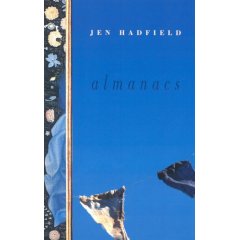
Jen Hadfield & Almanacs

I've been having some email conversations recently with a poet called Jen Hadfield, who lives some 600-odd miles north of London in the remote Shetland Islands, so I thought I'd post something up here about her work as she is only just beginning to make her mark on the UK poetry scene.

Jen Hadfield was born in Chesire in 1978 and is half-Canadian, as I understand it. She's published one full-length poetry collection with Bloodaxe, entitled 'Almanacs' (you can buy it here on amazon.co.uk), and is also an artist - click here to find some of her work at the Peedie Gallery, Orkney. For samples of Jen Hadfield's poetry and more about her life and various preoccupations, you can visit her website Rogue Seeds.


Her poetry is both delicate and muscular, which is an odd combination; I think it's the form which seems delicate to me, and the language which comes across as muscular. Living in the Shetlands, Jen is obviously influenced by that rugged scenery in terms of language and imagery, yet the forms she chooses tend to dance around, refusing to be pinned down and often inhabiting odd parts of the page, reminding me of some avant-garde work I've read, though rarely as opaque!

In spite of the rural Scottish connection, these are not poems about wild flowers and seascapes, although those can be found in her work, naturally enough. Instead, there's a sophisticated world-trekking mindset behind her poetry which requires a far larger - and wilder - canvas than the simple mainstream lyric, and the characters she adopts in her narrative-style poetry suggest an eccentric novelist or playwright working in a tighter form. Which is not to say that poetry isn't her form, just that she appears to be doing something very different and more ambitious with it in comparison to many of her peers. Basically, Jen Hadfield's first collection of poetry is Gordon Wardman's Hank meets Alan Warner's Morvern Callar meets High Plains Drifter. Confused? Well, that's what Google is for.

She's at work now on her second collection, Nigh-No-Place, amongst other things. Definitely one to watch ...

Tuesday, December 27, 2005

Deryn Rees-Jones’ MODERN WOMEN POETS: Mina Loy and the structure of poetry

I’ve been reading my way voraciously through Deryn Rees-Jones’ recent anthology of MODERN WOMEN POETS (Bloodaxe 2005) and making some fascinating discoveries about the history of women’s poetry over the last century. I would very much like to read the companion volume, CONSORTING WITH ANGELS: ESSAYS ON MODERN WOMEN POETS, also by Deryn Rees-Jones, but have only just ordered it from Bloodaxe and so will have to be content with the tantalisingly brief introductions to each poet in this anthology until it arrives.

The experimental poet Mina Loy (1882 - 1996) was born in London but later became a US citizen; the only two collections published during her lifetime were Lunar Baedecker (1923) and Lunar Baedecker & Time-tables (1958). Some of her comments on writing poetry - from an essay entitled ‘Modern Poetry’ quoted in the anthology’s introduction to her work - seem extremely astute and worth repeating here: 'The structure of all poetry is the movement that an active individuality makes in expressing itself. Poetic rhythm ... is the chart of a temperament.'
(Lost Lunar Baedeker, p. 157 - pub. posthumously in 1996/7.)

This makes supreme sense to me, for how else could poetry be constructed, except by way of reference to the self? Even the rules of formal verse are interpreted a different way by each practitioner. Free verse, by contrast, which has gradually become the standard in modern poetry since Loy herself first began writing at the turn of the century, has no precise set of rules, no absolute requirements before it can be called ‘poetry’. So how does the poet go about choosing a form in the face of such apparently unregulated freedom, unless he or she starts by looking within?

Mina Loy says - specifically to women writers in her ‘Feminist Manifesto’ - ‘Leave off looking to men to find out what you are not - seek within yourself to find out what you are.’
(Lost Lunar Baedeker, pp. 153-54)

Wise - if problematic - advice to women poets, now as then; we may well win praise and prizes for writing in a male idiom, but there’s too often an emptiness to the echo, a lack of self-investment in the work which eventually betrays it. How many male poets write like women? And what would we think of their work if they did? (I can hear the machine-guns being trundled out along the wall even as I write that ... )

Poetry may be ‘heightened speech’ but it is still very much an individual’s speech, the voice of that particular poet, not anyone else's. With that individuality comes eccentricity of theme and word selection; highly characteristic variations in line length; breaking the line at a certain word when another poet might have chosen to break after the following word, or perhaps the preceding one; choosing a particular title, or a number instead of a title, or no title at all; writing a prose-like narrative poem, or an elliptical modernist connotation of language and sound, or something more in the style of self-referential epigrammatic postmodernism.

In other words, we are all the sum of our parts, a combination of individual quirks, influences and past experiences, and blessed with a desire to experiment or consolidate, according to our nature as human beings. And that sum total - or as Mina Loy puts it, our ‘temperament’ - informs our every decision, from which hand is dominant to where we break the line in a poem.

For a comprehensive website devoted to this experimental modernist poet, featuring extracts from Mina Loy's poetry and writings, contemporaneous art and poetry that inspired her, and some unusual photographs - there was more than a streak of Victorian decadence in Ms Loy - visit this page first and then the home page of Jenifer Wolkowski's Mina Loy Website .